By Ben DiVito and Willie Summers
Lieutenant Jaime Martinez of Chicago Fire Engine 78 has had a unique perspective on the physical and cultural changes on Wrigleyville. Fire Engine 78 is stationed along Waveland Avenue across from Wrigley Field’s left-field bleachers.
He brought up an interesting point when he was asked about the biggest change to the neighborhood.
“All of this Wrigley stuff, that’s the biggest change,” he said. “Anything that has to do with the Cubs that’s the biggest change in the neighborhood. Popping buildings up left and right, but it looks beautiful.”
Over the past decade, Wrigleyville has gone through tremendous change with millions of dollars invested in the neighborhood by the Cubs and retail developers.
But beyond the physical change, the neighborhood also has seen changes in social, real estate and crime.
Niko Maviano, founder of the blog Southport Corridor, described the steady increase in the neighborhood’s crime over the past decade.
“There are places in the city with crime a million times worse than [Wrigleyville],” said Maviano, who also noted that Wrigleyville crime is like a, “Bell Curve where crime wasn’t too bad 10 years ago, but I’d say in [20] 14, 15, 16 it started to get bad.”
According to the Chicago Police Department’s 2017 Annual Report, the most popular crime to occur in the Lakeview sector was theft. There were 2,260 reported theft cases in Lakeview in 2017. Including theft, the total number of reported crime cases reached 3,200. In the Chicago Police Department’s 2018 Annual Report, crime and theft increased even more. There were a total of 2,314 reported thefts.
The latest data published by the Chicago Police Department goes only until 2018. According to the report, crime in Wrigleyville rose by 1.31% in 2018 from 2017 for a total of 3,242 crime cases reported in the area.
Officials at Chicago Police District 19, headquartered at 850 W. Addison St., which is two blocks east of Wrigley Field, declined to comment for this story.
Maviano also said that police are always heavily patrolling Wrigleyville, especially Clark Street on event days at Wrigley Field. With so many bars in Wrigleyville it is far from uncommon that fights break out at these bars which leads to an increase in crime.
Maviano gave further input and his own opinions on the current status of crime in Wrigleyville, and what can be done so that these levels of crime can decrease in the future.
“One thing that has gotten better, but can always improve is the crime.” Maviano said, “There’s always going to be an aspect of crime. That would be the only thing I would say could be improved. More police and less crime in the neighborhood.”
Wrigley Field opened in 1914 and contains many unique characteristics, but perhaps the most unique characteristic of Wrigley Field is that it is located in the middle of a neighborhood called Wrigleyville. The neighborhood is home to many iconic bars and restaurants and the stretch of Clark St. that runs through Wrigleyville is one of the most popular nightlife areas in Chicago.
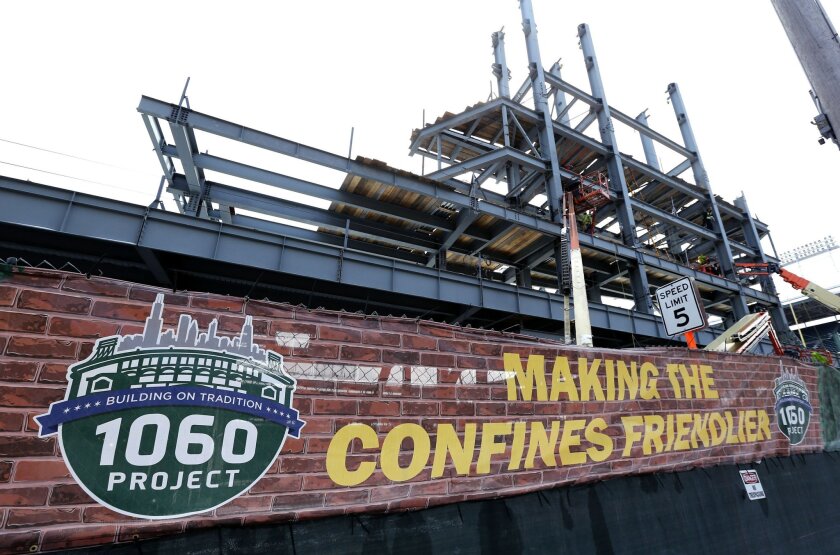
In 2009, the Ricketts family bought the Chicago Cubs. In 2014, the Ricketts invested 575 million dollars into the 1060 project, which renovated Wrigley Field as well as Wrigleyville. New additions to Wrigleyville include Gallagher Way, which is adjacent to Wrigley Field along Clark Street.
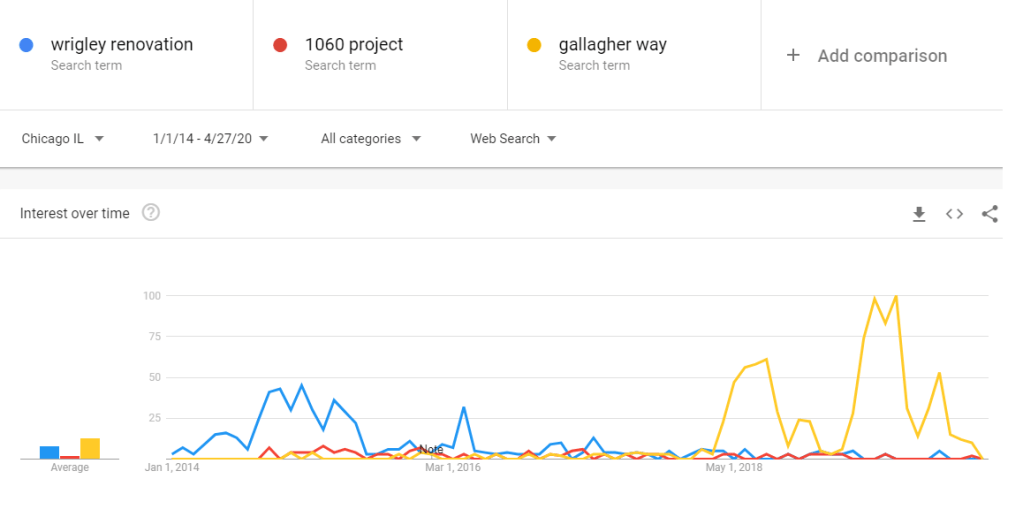
The 1060 Project had a high level of interest throughout the entire City of Chicago. According to a Google search analysis, the Wrigleyville renovations started to see a rise in searches from within the Chicagoland area, which corresponded to the time the Ricketts began to invest money and start the 1060 project in 2014. Gallagher Way saw a rise in searches as well in 2018 due to it’s announcement in April of that year.
A couple of other additions to Wrigleyville are Hotel Zachary across from the ballpark, a Lucky Strike bowling alley, and various restaurants such as a Shake Shack and Chipotle. These new additions are located at the intersection of Addison and Clark streets.
Maviano said year-round, family-friendly events have become essential to Wrigleyville. With the neighborhood being home to an ice rink in the winter time and numerous outdoor movie nights and local concerts during the summer, there are numerous ways for families to take advantage of the neighborhood. This was not the case a decade ago.
“The neighborhood itself has changed tremendously,” Maviano said. “It went from a college-type atmosphere with lots and lots of Irish pubs and bars and kind of like the party scene. It’s definitely turned over the last decade to more family oriented lots of more upscale restaurants to kids to families, lots of chains as opposed to mom and pop type shops have come in.”

Over the years, the amount of small neighborhood shops have decreased in Wrigleyville to make way for more chains and corporate shops and restaurants. While it is disappointing to see some of the small businesses in Wrigleyville have to close their doors, there is still a representation of small businesses in the area.
When asked about her favorite part about living in Wrigleyville, Lakeview resident Megan Pfersdorf showed that small businesses are indeed still a major part of the Wrigleyville culture.
“My favorite part is Two Hearted Queen, a coffee shop around the corner (from the intersection of Cornelia and Seminary avenues). All of the local businesses are awesome.”
However, Pfersdorf has taken note of the additional tourists that the renovations have brought into the neighborhood.
“My least favorite part is the tourist aspect. Like when there’s a bar crawl or something like that on Clark Street… In the summer it’s insane with the Cubs games, like April to October. There’s usually a lot of people not from the area.”
Pfersdorf shared how the new renovations have brought additional tourists to the neighborhood. The increase in tourist visitor traffic is not a welcome sight to all Wrigleyville residents.
Some residents say they would prefer to see more businesses appeal more to locals as opposed to aiming to draw tourists to the area, which has become a common occurrence under the recent renovations to Wrigleyville.
It is common to see a degree of crime in areas where there is a lot of money being thrown around. Wrigleyville is home to many bars and high class restaurants. While Wrigleyville is viewed by many as a fun loving neighborhood, the area was once a gang hotspot and to this day crime still occurs in the neighborhood.
Zach Jones of the website Chicagoganghistory.com analyzed numerous news articles, books, and conducted interviews, amongst other research to study Chicago’s gang history. Jones said Wrigleyville did have an extensive history with street gangs.
Although Wrigleyville is viewed by many as one of the safer neighborhoods in Chicago, the neighborhood had issues with crime and gangs throughout the 1950s, 1960s, and 1970s.
Based on Zach’s research and data, gang activity heightened largely throughout the 60s in Wrigleyville as the formation of the Puerto Rican gang “Latin Eagles” was formed in the area.
In 1964, the Latin Kings became prominent in the Lakeview area and soon a turf war began against them and the Latin Eagles. Only a few years later in 1968, the Puerto Rican Stones gang arrived in the area and opposed both the Latin Eagles and Kings.
Gang activity continued to rise in the 1970s as the Simon City Royals gang developed and started recruiting in the Lakeview area. The Royals were rivals against the Kings, Eagles, and the Stones. The 1970s were some of the worst times for the Wrigleyville area as all of these gangs were fighting and dealing drugs throughout the area.
Jay Gentile from Thrillist conducted an interview with Joe Shanahan who owns the famous music venue known as the Metro. When discussing Wrigleyville in the early 1980s, he talked about his own experience with opening his club through that time.
“The Cubs weren’t playing very well then and the area was dicey,” Shanahan said, “I remember most nights we didn’t let any of the cash walk out without at least four guys taking it to the local bank for a nighttime deposit. There was a lot of heroin and a lot of gangs, so we got to know our alderman and the commander CPD guys real quick. They were happy we were bringing music and a kind of cultural shift into Wrigleyville at that time.”
In the mid 1980s, many single people started moving into the area, ignoring the gang activity that was occurring throughout. Due to all the younger people starting to move in, housing prices started to rise.
Timeline: History of Wrigleyville
With all the young people populating the majority of the area, gangs began to die out in Wrigleyville. Come late 1980s early 1990s, most gang activity had moved from the Lakeview/Wrigleyville area elsewhere, and the new single crowd took over.
After the gangs left Wrigleyville, the neighborhood became primarily geared for younger people, especially those in college or recent college graduates. The neighborhood stayed as a hotspot for young people for many years.
In recent years, more crime is being reported largely in part because of the advancements of cell phones and social media. There are numerous Twitter pages and blogs regarding Wrigleyville crime such as the popular blog titled Crime In Wrigleyville.
Social media allows for everyone to see the type of crime that is being reported along with the crime frequency. Because of that, people are more aware of the crime that is occuring in the area. As Maviano mentioned, crime can happen at any time and anywhere. However, the advancement of crime reporting on social media has allowed for residents to become more aware of the crime that is occurring more than ever before.
“I also think part of it is things were just getting reported via social media way more,” he said. “You know there was that blog that started, Crime In Wrigleyville and that really shed a light on how much crime was happening, that I think most people would have never known about had that blog not been started.”
 Willie Summers Digital Journalism